
Next Steps
If you have not yet been allocated, there are still opportunities available through the steps detailed below.
A graduate year is just one way to begin your career journey. We also encourage you to consider the other pathways and opportunities outlined further down this page.
Late Vacancy Process
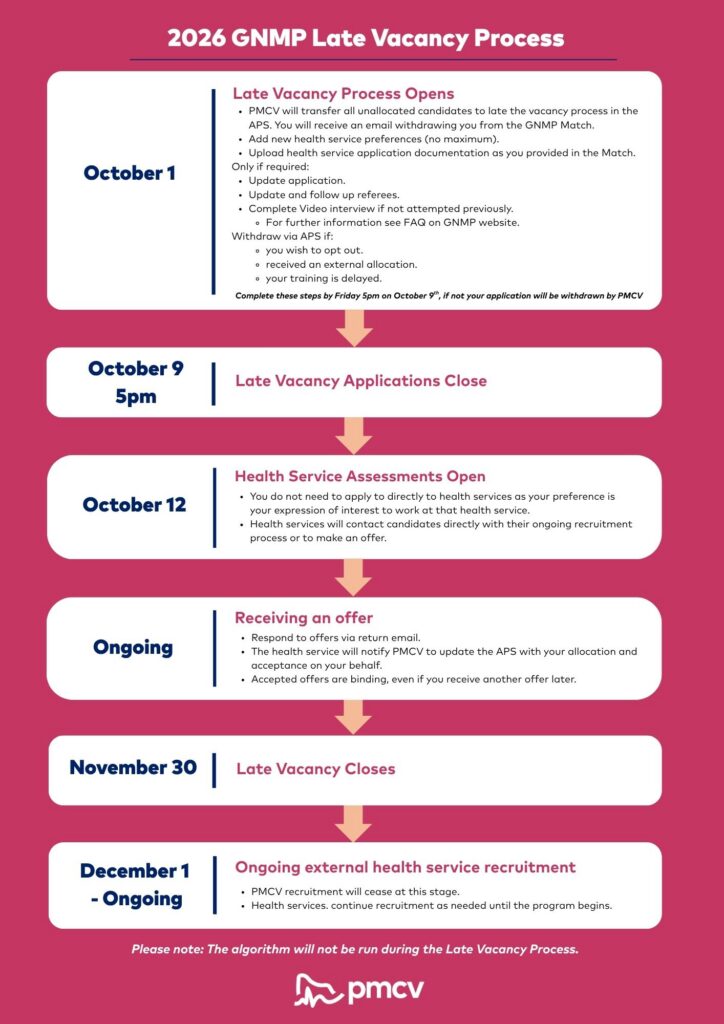
The 2026 GNMP Late Vacancy process opens Thursday, 1 October 2026.
- PMCV will transfer eligible unallocated Match candidates into the Late Vacancy process in the APS.
- You will receive an email advising that your original GNMP Match application has been withdrawn. This is part of the transfer process and does not mean you have been withdrawn from Late Vacancy.
- All your application details will transfer across, except your preferences and uploads required to establish eligibility.
What you need to do
The APS opens at 10am Thursday 1 October and closes 5:00 pm, Friday, 9 October 2026. You do not need to re-register with PMCV.
As soon as possible during this time:
- Add your preferences. Select only Health Service programs where you would accept an allocation. There is no set maximum. Your preference list is your Expression of Interest, so do not apply directly to these Health Services.
- Upload your documents to the APS. Upload the documents you previously provided to Health Services.
- Complete any required updates to your application, incomplete referees or video interview.
- Complete all required steps by the deadline. Incomplete applications will be withdrawn.
- See the Late Vacancy FAQs for more information about documents required to be uploaded, preferences, referees, video interviews and offers.
What happens next?
Health Services can begin assessing candidates from 10:00 am, Monday, 12 October 2026 and may contact you directly about an interview or offer.
Offers
- Health Services may arrange an interview or make offers directly to candidates.
- For questions about a position or Health Service application, contact the relevant Health Service directly.
- See the Late Vacancy FAQs for more information about documents, preferences, referees, video interviews and offers.
- Accept or decline an offer in writing (email) directly with the Health Service, within the timeframe they set.
- Once a candidate accepts an offer in writing, it is considered binding, no further offers may be considered.
Important
- PMCV will not run an allocation algorithm during the Late Vacancy process.
- PMCV can assist with APS application updates, resending referee links and providing video interview links until 5:00 pm, Friday, 9 October 2026.
- Late submissions cannot be accepted, as Health Services begin assessing candidates on Monday, 12 October 2026.
- PMCV will support the LVM process by recording accepted offers in the APS, removing filled positions from the Health Service Directory and assisting candidates and Health Services where required.
Other opportunities
- Graduates are encouraged to explore the Health Service Directory on PMCV’s website to find available graduate positions.
- Graduates can enter the nursing and midwifery workforce through avenues outside of the acute hospital graduate programs offered in the GNMP match.
- There may be opportunities available in areas graduates have not yet considered, including the aged care, primary and community care, mental health and disability sectors.
- Graduates are encouraged to look for roles beyond metropolitan Melbourne – there are graduate positions available in rural and regional health services, this can be a meaningful and rewarding way to start your nursing/midwifery career.
- Graduates can pursue further formal postgraduate studies or participate in a Transition to Practice Program, including through Commonwealth initiatives in aged care and primary care.
- Interstate opportunities – Click here to view positions available in the Limestone Coast – South Australia
Further Support
- Contact your university course coordinator
- Nursing and Midwifery Health Program Victoria provides assistance to students on work or life events – it is free, confidential, independent and is provided by experienced nurses and midwives.
Opportunities
Aged Care sector opportunities
Rural and regional opportunities
Mental Health sector opportunities
Explore public sector job boards
Private sector jobs
Further study and transition to practice options
Frequently asked questions
Q. Can I still work as a nurse or midwife without completing a formal graduate program?
Graduate programs are not mandatory, and there are many other ways to enter the nursing or midwifery workforce. Nursing and midwifery graduates have full registration and can be employed in their first year of practice in any health, community or aged care setting in the private or public sector without undertaking a formal graduate program.
Q. Do all public health services in Victoria use the annual PMCV graduate match and/or offer all graduate positions via this process?
All public health services in Victoria can participate in the annual PMCV graduate match if they have positions available.
Q. Will I be disadvantaged if I don’t get a graduate program?
No. Graduate programs are not mandatory for employment as a registered nurse or midwife. Graduates can begin their careers in entry-level roles outside formal programs and still go on to build successful and fulfilling careers.
You might consider starting in:
- Aged care, disability, or primary and community health
- Private hospitals and health services
- Regional and rural health services
- Mental health or custodial services
Practical experience, adaptability, and a commitment to ongoing learning will place you in a strong position to begin your career. You can also pursue further study and professional development to support your progression. Your career path may look different, but it can still be rewarding and full of opportunity.
What study options are available to graduates to support career progression?
Further study
Further study can help graduates build specialised knowledge and explore new career pathways. Options include:
- Postgraduate nursing degrees in areas such as mental health, oncology, critical care, and paediatrics.
- Postgraduate or entry-to-practice midwifery programs for those looking to transition into midwifery.
University course coordinators can help graduates explore study options tailored to their interests and goals.
There are also several scholarship programs available to support further study:
- Australian College of Nurse Practitioners scholarships
- Aged Care Nursing Scholarship Program
- Primary Care Nursing and Midwifery Scholarships
- Full Course Fee Postgraduate Mental Health Nurse Scholarship Program – a fully funded initiative for those pursuing mental health nursing. More information is available at Full Course Fee Postgraduate Mental Health Nurse Scholarship Program | health.vic.gov.au
What study options are available to graduates to support career progression?
Transition to Practice Programs
These programs provide structured support as graduates transition from study into the workforce:
- Aged Care Transition to Practice Program – funded by the Australian Government, this program supports new aged care nurses with training and professional development.
- Nursing in Primary Care Transition to Practice Program – delivered by the Australian Primary Health Care Nurses Association (APNA), this is for graduate nurses working in primary healthcare who have graduated in the past two years and haven’t completed a transition program.
APNA also offers a job-matching service to connect graduates with employers in primary care settings.
Dual Degree Pathways
Graduates with dual degrees may also consider career pathways that utilise both qualifications.
For example, for graduates of a dual degree in nursing/paramedicine, the Graduate Ambulance Paramedic Program offers a structured graduate year for paramedics. Students in their final semester of a Paramedicine Board of Australia-recognised qualification are encouraged to register their interest. Applications and enquiries are accepted year-round. This pathway can be a valuable option for those looking to explore the paramedicine side of their dual qualification.