-
-
-
I didn’t get a Match what happens next?
As outlined in the Candidate Guide, PMCV will run the matching algorithm again on Wednesday 23 September, following the initial accept/decline period. This allows any declined positions and remaining vacancies to be offered to eligible unallocated candidates where possible.
Only candidates that receive an allocation will be notified by email.
Late Vacancy Management (LVM) Process
Who is this process for?
- Candidates with a Registered Approved status, who did not receive an allocation.
- New/Non-PMCV candidates who did not participate in, withdrew from, or were ineligible for the Match may still participate in the Late Vacancy process, however they must follow the separate application process directly with Health Services.
Who is not eligible?
- Candidates who received an allocation through the Match cannot participate to seek a different allocation. Match allocations are binding.
- Candidates who have an external offer with a private health service or interstate, must withdraw if still in the APS.
When does the LVM open?
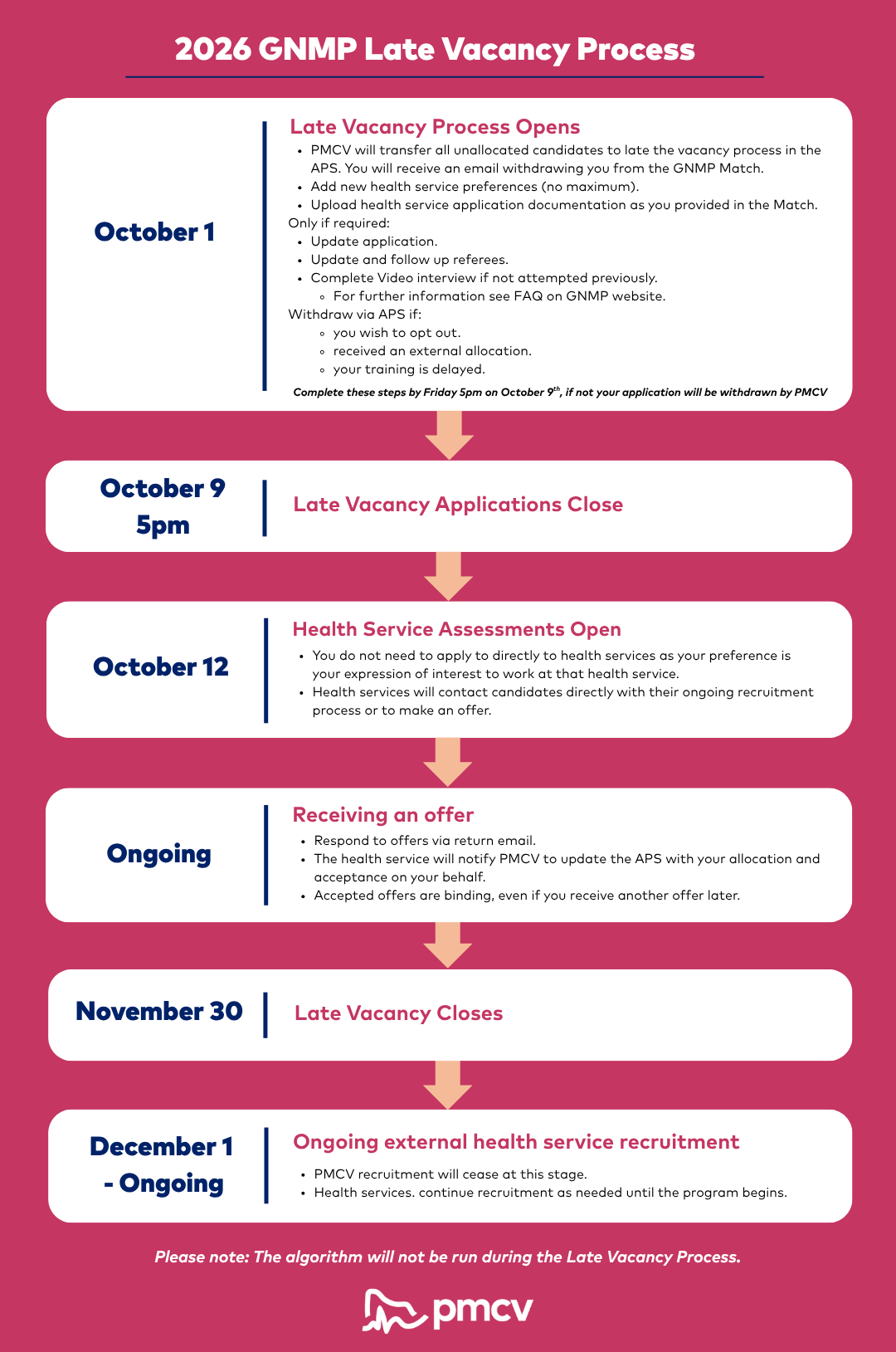
The Late Vacancy process opens on 1 October 2026.
Your application details will be transferred across by PMCV. Your existing GNMP Match application will appear as withdrawn.
You can only update your application, preferences or referee details once the process opens.
What do I need to complete by 5:00 pm, Friday, 9 October 2026?
All candidates wishing to participate in the PMCV LVM portal must:
- Add preferences for the Health Service programs where you are genuinely willing to work and would accept an offer.
- Upload the required supporting documents to the APS.
If required, you should also:
- Update your key application details and Career Intentions Statement.
- Add or update referee details.
- Complete a video interview if you did not complete one during the Match. Contact PMCV to request a new link, as the link in the APS will not be active.
Your portal autosaves, so there is no submit button.
Do I need to apply directly to Health Services?
No. If your previous Match application has been transferred to the Late Vacancy process, do not apply directly to the Health Services on your preference list. Adding a Health Service program to your preference list is your Expression of Interest for that position.
Different process for new/non-Match candidates: Candidates who did not participate in, withdrew from, or were ineligible for the Match apply directly to Health Services. The PMCV referee and video interview instructions in these FAQs do not apply to these candidates.
How many preferences can I add?
There is no set maximum. The number of preferences available will depend on the Health Service programs with vacancies.
Only preference programs where:
- you are genuinely willing to work and would accept an offer;
- you meet the qualification requirements; and
- you can commence on the advertised intake date.
Specialty program allocations and intake dates are managed by individual Health Services.
What documents do I need to upload?
Upload the supporting documents previously provided to Health Services during the Match, including:
- a non-Health-Service-specific cover letter
- CV or résumé
- academic transcript
- ANSAT
- clinical feedback forms
- other supporting documents requested or previously provided to Health Services.
Where possible, upload documents in PDF format to the uploads section of your APS application.
What is a non-Health-Service-specific cover letter?
If you are preferencing multiple Health Services, your cover letter should be generic rather than addressed to one particular Health Service or location.
Focus on your career goals, interests, experience and what you can offer as a graduate nurse or midwife.
If you are only preferencing one Health Service, your cover letter can be more specific to that service.
Who can see my uploaded documents?
Your uploaded documents can be viewed by all Health Services on your preference list.
For this reason, make sure documents such as your cover letter are appropriate for all the Health Services you select.
What do I need to do about my referees?
You should already have nominated two clinical referees during the Match.
If you have two completed referee reports:
No action is required.If a referee report is incomplete:
- Confirm your referee is still willing and available to complete the report within the short timeframe.
- Check their email address carefully, particularly if they did not receive the original request.
- Enter or update their details as early as possible. Referees are contacted when you save their details.
- Make sure your referee meets the referee requirements.
- Monitor your referee reports and follow up directly with your referees if required.
Candidate deadline: Complete referee nominations or changes by 5:00 pm, Friday, 9 October 2026.
Referee deadline: Reports must be submitted by 11:59 pm, Sunday, 11 October 2026. No extensions are available.
Who can be my clinical referee?
Your referee must be a registered nurse or midwife with at least one year of experience who has directly supervised you in a student clinical setting, for example a preceptor, Nurse Unit Manager (NUM) or educator.
Do not nominate personal or non-clinical referees.
Can PMCV resend my referee’s link?
Yes. First, check that the referee’s email address in your application is correct.
Then email allocations@pmcv.com.au and ask PMCV to resend the link.
This option is not available to new/non-Match candidates applying directly to Health Services.
Can I change a referee who has already completed their report?
You can, but this is not recommended during the Late Vacancy process because of the short timeframe.
If you remove a referee who has already completed a report:
- their completed report will be deleted and cannot be restored; and
- the referee will be notified by email.
A newly nominated referee may not have enough time to complete a replacement report before the deadline.
Can I complete or redo my video interview?
You can complete a video interview only if you did not attempt one during the Match.
A completed video interview cannot be redone unless there were visible technical issues affecting the audio or video.
Email PMCV to request a video interview link. The existing link in the APS will not be active.
This option does not apply to new/non-Match candidates applying directly to Health Services.
I withdrew from the Match. Can my Match application be reinstated?
No. A withdrawn Match application cannot be reinstated.
You can still participate in the Late Vacancy process through the separate application process directly with Health Services.
When can Health Services start assessing candidates?
Health Services can commence assessment from 10:00 am, Monday, 12 October 2026.
How do I accept an offer from a Health Service?
Follow the instructions in the Health Service’s offer email and reply within the timeframe they provide.
Once you accept an offer, you cannot later decline it because you receive another offer.
The Health Service will forward your acceptance to PMCV, or you can copy PMCV into your acceptance email.
PMCV will then update your allocation in the APS.
Why can’t I accept my offer in the APS?
During the Late Vacancy process, candidates do not accept offers through the APS.
Accept the offer directly with the Health Service by email. Once PMCV receives confirmation of your acceptance, PMCV will update your allocation in the APS.
What are the main dates to mark in my calendar?
Are there other opportunities outside the Match and Late Vacancy process?
Yes. If you are not successful through the match process, there may still be other employment opportunities available.
Throughout the year, particularly at the end of the year, the start of a new year, and sometimes mid-year, vacancies can arise when candidates withdraw or circumstances change. Public health services may advertise these positions directly on their own websites, as well as through recruitment platforms such as Seek.
Private health services may also have vacancies become available outside of the formal match process.
In addition, nursing offers a wide range of rewarding career pathways. Opportunities may be available in areas such as Rural & Regional Health, General Practice (GP) Nursing, Travel Nursing and Aged Care, allowing you to continue building your skills and experience while exploring different career options.
We encourage you to stay proactive, regularly check employer websites and job boards, and remain open to the many opportunities available across the healthcare sector.
Can I still work as a nurse or midwife without completing a formal graduate program?
Yes. Graduate programs are not mandatory. Nursing and midwifery graduates hold full registration and can be employed in any health, community, or aged care setting in either the public or private sector without completing a formal graduate program.
Will I be disadvantaged if I don’t get a graduate program?
No. Graduate programs are not mandatory for employment as a registered nurse or midwife. Many graduates begin their careers in entry-level roles outside formal programs and go on to build successful and fulfilling careers.
You might consider starting in:
- Aged care, disability, or primary and community health
- Private hospitals and health services
- Regional and rural health services
- Mental health or custodial services
Practical experience, adaptability, and a commitment to ongoing learning will place you in a strong position. You can also pursue further study and professional development to support your progression. For more information, visit the Career Opportunities page on this website.
What further study options are available to support my career progression?
Further study can help you build specialised knowledge and explore new career pathways. Options include:
- Postgraduate nursing degrees in areas such as mental health, oncology, critical care, and paediatrics
- Postgraduate or entry-to-practice midwifery programs for those looking to transition into midwifery
University course coordinators can help you explore study options tailored to your interests and goals.
Several scholarship programs are also available to support further study:
- Australian College of Nurse Practitioners scholarships
- Aged Care Nursing Scholarship Program
- Primary Care Nursing and Midwifery Scholarships
- Full Course Fee Postgraduate Mental Health Nurse Scholarship Program a fully funded initiative for those pursuing mental health nursing. More information is available at health.vic.gov.au.
Are there structured transition programs available outside of formal graduate programs?
Yes. The following programs provide supported pathways into the workforce:
- Aged Care Transition to Practice Program funded by the Australian Government, this program supports new aged care nurses with training and professional development.
- Nursing in Primary Care Transition to Practice Program delivered by the Australian Primary Health Care Nurses Association (APNA), this program is for graduate nurses working in primary healthcare who have graduated within the past two years and have not completed a transition program.
APNA also offers a job-matching service to connect graduates with employers in primary care settings.
I have a dual degree are there specific pathways I should consider?
Yes. Graduates with dual degrees may be able to pursue career pathways that draw on both qualifications.
For example, graduates of a dual nursing and paramedicine degree may wish to explore the Graduate Ambulance Paramedic Program, which offers a structured graduate year for paramedics. Students in their final semester of a Paramedicine Board of Australia-recognised qualification are encouraged to register their interest. Applications and enquiries are accepted year-round.
-
Am I eligible to participate in the 2026/27 Matching Process?
Refer to the Eligibility Criteria on the Match webpage to confirm your eligibility. Participants generally include:
- Final-year students in registered nursing, registered midwifery, or dual nursing/midwifery
- Postgraduate diploma of midwifery students (clinical placement only)
I’m not finishing my course till maybe December 2026 or January 2027, should I apply to the 2026 Match?
You should submit your application this year. Candidates are expected to apply in the year they complete their training. We have had many December 2025 candidates who were disappointed because they did not realise this requirement.
Even if your training is slightly delayed, you may still be eligible to start in a later intake, such as February or beyond. However, if you do not apply this year, you will not be able to apply next year if your training is completed in 2026, only if it completes in 2027 when you can apply again, if unsuccessful in 2026.
I applied to the 2025 GNMP Match, can I reapply for the 2026 Match?
This depends on your individual circumstances. Please read carefully, in most cases the answer is below.
You can reapply if either of the following apply to you:
- Your training was delayed and you will finish in 2026 -If you applied to the 2025 Match but your training completion date was delayed, you may reapply — provided your new completion date falls within the 2026 eligibility window of 1 January 2026 to 30 June 2027. Please note this refers to your training completion date, not your graduation or AHPRA registration date.
- If you were successfully matched and accepted a position in 2025 but were unable to commence due to a training delay into 2026 or a PMCV pre-approved Special Consideration (such as parental leave), you are eligible to reapply for 2026.
You cannot reapply if the following applies to you
- If you completed your training in 2025 and were unsuccessful in the 2025 Match, you are not eligible to reapply for the 2026 Match unless you hold written confirmation of a PMCV pre-approved Special Consideration (for example, parental leave).
- If you believe Special Consideration may apply to you, please email allocations@pmcv.com.au with supporting documentation.
I completed my training before 1 January 2026. What are my options?
You are not eligible for the 2026 Match (positions commencing in 2027), unless your training completion was delayed from 2025 into 2026 — in which case you may reapply.
If you are not eligible, consider:
- Private health facilities
- Seek or Careers.Vic for available positions
- The Opportunities section on the GNMP website for other ways to start your career
I was unallocated in the 2025 Match. Can I reapply?
No. Each year’s Match is open to newly eligible candidates only. Applicants who were unmatched in a previous year cannot re-enter.
The only exception is if your training completion was delayed, making your new training completion date 2026. Note that this refers to your training completion date, not your graduation date.
I’ve already started a graduate year. Can I apply again?
Yes, with restrictions:
- If you completed a nursing graduate program, you may apply for midwifery only roles.
- If you completed a midwifery graduate program, you may apply for nursing only roles.
- You cannot apply for positions in the discipline where you have already completed a graduate year.
If I apply for positions outside the Match, am I still eligible for the GNMP Match?
Yes. You may apply through both the PMCV GNMP Match and directly to other employers (such as private hospitals or interstate programs) at the same time.
However:
- If you accept a position outside the Match, you must withdraw from the GNMP Match before the final closing date.
- If you remain in the Match past the cutoff and receive an allocation, that allocation is binding. See the Code of Conduct for more details.
Can I apply for a mid-year graduate program?
Yes. Mid-year intakes are part of the same annual Match — there is no separate mid-year process. To be considered for a mid-year 2027 intake, you must participate in the 2026 Match.
To find mid-year opportunities:
- Check the Health Service Directory for services offering multiple intakes
- Review health service application forms to indicate which intake(s) you are interested in
- Contact health services directly if you need clarification
I previously completed an EN graduate program and am now studying to be an RN. Am I eligible?
Yes. The GNMP Match is for RN qualified applicants and is separate from EN graduate programs, so your prior EN graduate program does not affect your eligibility.
Will my conferred date be accepted as my Completion of Training date?
No, these dates are often confused, but they mark different stages of the graduation process:- Date Completed: The day you finish your final exam, submit your last assignment, and meet all academic requirements.
- Date Conferred: The administrative date only, which can be weeks or months after completion, when the university’s governing body (like the Senate or Council) officially approves the degree and issues your diploma/testamur.
What positions are offered in the GNMP Match?
The Match includes the following graduate streams:
- Nursing
- Mental Health
- Midwifery
- Dual Nursing/Midwifery
- Postgraduate Midwifery
Positions are predominantly within Victorian public health services, plus two private health services.
I am a Priority Group Two candidate — what are my chances of being allocated?
PMCV is unable to predict individual outcomes, as results depend on candidate preferences and health service rankings. That said, many candidates in similar situations are successfully allocated each year. Completing each stage of the process as thoroughly as possible gives you the best chance of a good outcome.
I will finish my training in late June 2027. Should I apply for the 2026 or 2027 Match?
We recommend applying for the 2027 Match. While you may be technically eligible for the 2026 Match, the timing of start dates and AHPRA registration means very few programs would be available to you, significantly reducing your chances of success. You would also need to go through the full application, video interview, and health service interview process twice.
Applying in 2027 gives you access to the full range of programs and the strongest chance of a successful outcome. You are permitted to work without restrictions in the lead-up to positions commencing in 2028.
You may only apply for both years if you are unsuccessful in 2026. If you receive an allocation in 2026, you cannot decline it or withdraw in order to try again in 2027.
I have just found out I am pregnant. Should I apply this year or request Special Consideration for the 2027 Match?
If you are unable to commence a program in 2027, applying in this year’s Match may put you in a difficult position. If you were allocated a position and could not take it up, you would be relying on the health service to offer a deferral — and most have limited capacity to do so. A deferral can leave a health service short-staffed for the year, and many are unable to repeat their recruitment process to fill an unexpected vacancy. If a deferral cannot be offered, the position would be withdrawn and you would remain unmatched.
Choosing to wait and apply in the 2027 Match avoids going through the entire process twice and gives you access to a broader range of programs. If you were offered a deferral this year, you would also be tied to that allocation even if your circumstances change.
Ultimately, the decision is yours — but please be aware that a deferral is not guaranteed if you are allocated through this year’s Match.
To request Special Consideration for the 2027 Match, simply submit either a birth certificate or a letter from your doctor.
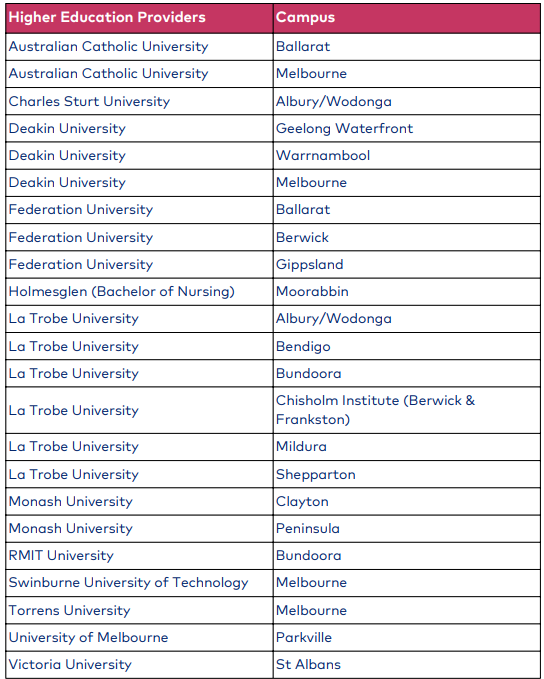
Who are the eligible education providers in Victoria?
-
-
-
-
-
-
Do I need to meet the English Language Skills (ELS) registration standard?
Yes. To be registered as a nurse or midwife in Australia, you must meet the English Language Skills (ELS) standard. This requirement is set under the National Law and ensures all practitioners have the level of English needed to practice safely.
You must meet this standard if:
- You are applying for nursing or midwifery registration in Australia for the first time, or
- You are applying for registration (including moving from non-practising to another registration type) and have not used English as your primary language for more than five years
For full details, visit: Nursing and Midwifery Board of Australia – English Language Skills.
Do I need to submit my English language test results to PMCV?
No. You do not need to upload English test results to PMCV. However, you must indicate in your application:
- Which English language pathway applies to you, and
- The status of your English Language Skills Test (if relevant)
Health Services will require you to meet the same English language standard needed for initial AHPRA registration.
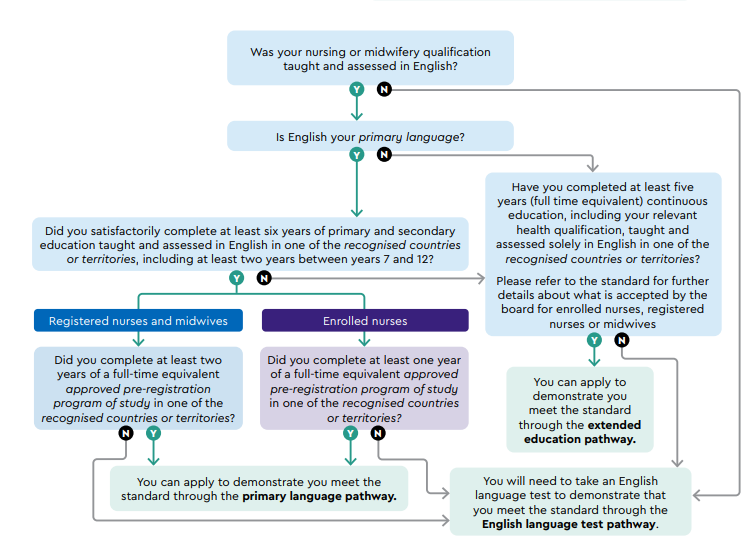
I grew up and studied in Australia. Which pathway do I use?
If you grew up and completed all your education in Australia, select the Primary Language Pathway.
Which countries are recognised for the Primary Language Pathway?
Antigua and Barbuda, Anguilla, Australia, The Bahamas, Barbados, Belize, Bermuda, British Indian Ocean Territory, Canada, Cayman Islands, Dominica, Falkland Islands, Gibraltar, Grenada, Guernsey, Guyana, Isle of Man, Jamaica, Jersey, Malta, New Zealand, Republic of Ireland, Saint Helena (Ascension and Tristan da Cunha), St Kitts and Nevis, St Lucia, St Vincent and the Grenadines, Trinidad and Tobago, United Kingdom, United States of America, and US Virgin Islands.
I didn’t attend secondary school in a recognised country, but I’ve studied in one for several years. Which pathway applies?
You may be eligible under either of the following pathways:
Primary Language Pathway — if English has been your primary language throughout your education.
Extended Education Pathway — if you can provide evidence of all of the following:
- At least five years of full-time equivalent continuous education
- Taught and assessed in English
- Completed in a recognised country
- Including your nursing or midwifery tertiary qualification
If your nursing or midwifery qualification was not taught and assessed in English in a recognised country, you will need to meet the ELS standard through the English Language Test Pathway.
Pathways diagram
-
-
-