
Frequently Asked Questions
How to use this page
- Click the arrow next to each section to expand and view commonly asked questions and their answers.
- Use the search bar to quickly find all mentions of your topic across all pages.
My referee details were entered incorrectly, can I change these
Yes, you can amend all the details including the email address yourself and it will automatically re-send the referee the email.
Do I need to remind my referee to complete their report?
Yes, it’s ultimately your responsibility if your referee reports are completed in time. Please follow up directly with the referee, this ensures they did receive the link and you know if their intent is to complete it. PMCV will not send manual reminders as prompts, you need to talk to the referee.
PMCV will send automated reminders at:
- 14 days
- 7 days and
- 2 days before the report due dates.
My referee didn’t receive the form—what can I do?
- Verify the email in Nominate Referees is correct.
- Ask them to check junk/spam.
- Check if the referee is prepared to give you an alternate email address.
- Before the deadline, email allocations@pmcv.com.au with your details and the referee’s details so PMCV can attempt a resend.
Note: Some domains (e.g., .gov.au, RCH) block external emails—an alternative email may be needed.
My nominated referee is no longer available. Can I nominate another?
Yes, you can remove the referee before the referee deadline. Then add a new referee ensuring you are allowing sufficient time for completion. The referee you remove will receive an email notifying them that they were removed. This is the same for all incomplete reports.
Can I remove a completed reference report and add a new referee?Yes, but the report will be deleted immediately and cannot be recovered for any reason. The referee will also be notified that you removed their report.
Who can access my referee reports?
Only the Health Services you preferenced. PMCV collects reports but does not read or assess them.
Can I view my referee reports?
No. All reports are confidential.
Can I still work as a nurse or midwife without completing a formal graduate program?
Graduate programs are not mandatory, and there are many other ways to enter the nursing or midwifery workforce. Nursing and midwifery graduates have full registration and can be employed in their first year of practice in any health, community or aged care setting in the private or public sector without undertaking a formal graduate program.
Do all public health services in Victoria use the annual PMCV graduate match and/or offer all graduate positions via this process?
All public health services in Victoria can participate in the annual PMCV graduate match if they have positions available.
Will I be disadvantaged if I don’t get a graduate program?
No. Graduate programs are not mandatory for employment as a registered nurse or midwife. Graduates can begin their careers in entry-level roles outside formal programs and still go on to build successful and fulfilling careers.
You might consider starting in:
- Aged care, disability, or primary and community health
- Private hospitals and health services
- Regional and rural health services
- Mental health or custodial services
Practical experience, adaptability, and a commitment to ongoing learning will place you in a strong position to begin your career. You can also pursue further study and professional development to support your progression. Your career path may look different, but it can still be rewarding and full of opportunity.
What study options are available to graduates to support career progression?
Further study
Further study can help graduates build specialised knowledge and explore new career pathways. Options include:
- Postgraduate nursing degrees in areas such as mental health, oncology, critical care, and paediatrics.
- Postgraduate or entry-to-practice midwifery programs for those looking to transition into midwifery.
University course coordinators can help graduates explore study options tailored to their interests and goals.
There are also several scholarship programs available to support further study:
- Australian College of Nurse Practitioners scholarships
- Aged Care Nursing Scholarship Program
- Primary Care Nursing and Midwifery Scholarships
- Full Course Fee Postgraduate Mental Health Nurse Scholarship Program – a fully funded initiative for those pursuing mental health nursing. More information is available at Full Course Fee Postgraduate Mental Health Nurse Scholarship Program | health.vic.gov.au
What study options are available to graduates to support career progression?
Transition to Practice Programs
These programs provide structured support as graduates transition from study into the workforce:
- Aged Care Transition to Practice Program – funded by the Australian Government, this program supports new aged care nurses with training and professional development.
- Nursing in Primary Care Transition to Practice Program – delivered by the Australian Primary Health Care Nurses Association (APNA), this is for graduate nurses working in primary healthcare who have graduated in the past two years and haven’t completed a transition program.
APNA also offers a job-matching service to connect graduates with employers in primary care settings.
Dual Degree Pathways
Graduates with dual degrees may also consider career pathways that utilise both qualifications.
For example, for graduates of a dual degree in nursing/paramedicine, the Graduate Ambulance Paramedic Program offers a structured graduate year for paramedics. Students in their final semester of a Paramedicine Board of Australia-recognised qualification are encouraged to register their interest. Applications and enquiries are accepted year-round. This pathway can be a valuable option for those looking to explore the paramedicine side of their dual qualification.
Am I eligible to participate in the 2025/26 Matching Process?
Refer to the Eligibility Criteria on The Match webpage to confirm your eligibility.
Participants include:
- Final‑year students in nursing, midwifery, dual nursing/midwifery, nursing/paramedicine, nursing/business etc.
- Postgraduate diploma of midwifery students (clinical placement only)
I completed my training prior to 1 January 2026. What are my options?
You are not eligible for the 2026 Match (positions commencing in 2027).
Only candidates from the 2025 Match whose training completion date was delayed into 2026 may reapply.
Please continue to look at Seek and/or Careers.Vic for any positions that may become available. Also look at the Opportunities section on the GNMP website for other opportunities to start your career.
I was unallocated in the 2025 Match. Can I reapply?
No. Each year’s Match is reserved for newly eligible candidates. Applicants who were unmatched in previous years cannot re-enter.
I’ve already completed a graduate year in nursing or midwifery. Can I apply again?
Yes, with restrictions:
- If you completed a nursing graduate program, you may apply for midwifery only roles.
- If you completed a midwifery graduate program, you may apply for nursing only roles.
You cannot preference positions in the discipline where you have already completed a graduate year.
If I apply for positions outside the Match, am I still eligible for the GNMP Match?
Yes. You may apply through both pathways:
- The PMCV GNMP Match, and
- Direct applications (e.g., private hospitals or interstate programs).
However:
- If you accept a position outside the Match, you must withdraw from the GNMP Match before the final closing date.
- If you remain in the Match past the cutoff and receive an allocation, the Match is binding. See the Code of Conduct for more details.
Can I apply for a 2026 mid‑year Graduate Program?
Yes. Mid‑year intakes are part of the same annual Match.
To be considered for a mid‑year 2026 intake, you must participate in the 2025 Match.
Some health services offer mid‑year programs (April–September 2026). Check:
- The Health Service Directory for multi-intake services
- Health service application forms to indicate which intake(s) you want
You may also contact health services directly for clarification.
I previously completed an EN graduate program and am now studying to be an RN. Am I eligible?
Yes. The GNMP Match is for RN‑qualified applicants, which is distinct from EN graduate programs.
What positions are offered in the GNMP Match?
This Match includes the following graduate streams:
- Nursing
- Mental Health
- Midwifery
- Dual Nursing/Midwifery
- Postgraduate Midwifery
Positions are predominantly within Victorian public health services, plus two private services.
Who are the eligible education providers in Victoria?
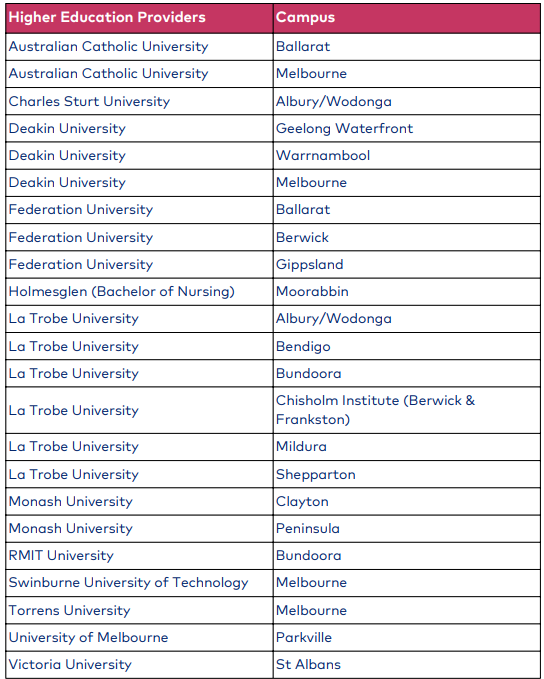
Do I have to complete a video interview for the Match?
PMCV strongly encourages all approved candidates to complete the video interview.
Most health services use these recordings as part of their assessment and/or shortlisting.
Your interview will be accessible to the health services you have in your preference list via the APS website.
The video interview forms an important component of the overall selection process.
How many questions will I be asked during the video interview?
The 2025 Video Interview questions are still being finalised.
More information will be available at a later date.
I am away during the interview period. What should I do?
You only need Wi‑Fi and a phone or laptop, and can complete the interview from any location or time zone.
Please ensure you set aside time in your calendar—it is your responsibility to complete the interview.
Does it matter what I wear for the video interview?
Yes. Treat it as a professional job interview and present yourself accordingly.
Can I review my answers?
No. You cannot watch back your responses once submitted.
Can I re-attempt my video interview answers?
No. You may only re-record the practice question.
Once the interview begins, you cannot reattempt a question unless there is a verified technical issue.
You cannot reattempt questions because you are unhappy with your performance.
Submitting some responses is better than none—please complete the interview.
Do I get to practice my video interview?
Yes. During the interview period you can:
- Test your technology
- Complete one practice question
You will not be able to re-watch your responses afterwards.
How do I access the video interview link?
When the interview period opens, log in to your GNMP account. A video interview button will appear in your application.
What if I have a technical problem setting up my laptop before the interview?
Seek assistance from family, friends, or troubleshooting resources (e.g., Google) to check your camera, microphone, and speakers. You must ensure you have a fully functioning device before starting the interview.
What if I have a technical problem during the video interview?
Contact PMCV during business hours only via allocations@pmcv.com.au
Glossary of Key GNMP Terms
Allocation – When the algorithm assigns a candidate to a Health Service based on preference order, ranking, and available positions.
Candidate – A person applying through the GNMP Match.
Distance Education – Victorian-based candidates studying online at an interstate university.
GNMP – Graduate Nursing & Midwifery Program.
Intake Month – The month your program is expected to commence.
International Students
- Eligible: Temporary residents with valid work rights, studying in Australia, graduating with Australian qualifications.
- Ineligible: Students with overseas‑obtained qualifications.
Multi‑Site Program – A program delivered across several linked Health Service locations.
Preference – The Health Services you list (in order) for consideration in the Match.
PMCV – Postgraduate Medical Council of Victoria — the administrator of the GNMP Match on behalf of the Department of Health.
How many preferences can I list?
In the PMCV GNMP Match you may preference up to six (6) health services.
Only preference health services where you are genuinely willing to work.
Do I have to preference four health services?
No, it is not mandatory to preference all six.
However, listing the maximum number increases your chance of receiving an allocation.
Only preference health services you are fully prepared to accept.
Is the preference order important?
Yes. Preference order is critical.
The matching algorithm considers:
- Your ranked preferences
- Each health service’s ranking of you
- The number of available positions
List health services in true order of preference, and do not include any where you are unwilling to work.
Is it okay to apply to multiple streams at only one hospital?
Yes, you may focus your application on one health service if you wish.
However, limiting yourself to a single organisation reduces your chances of being matched.
Having multiple health service options provides greater flexibility while still prioritising places you genuinely want to work.
Where can I find information about the health services in the Match?
Refer to the Health Service Directory located on the HS Directory page of the GNMP website.
Do I need to apply directly to the Health Services?
- Cover letter
- CV
- Academic transcript
- Residency or work rights documents
- Placement reports
- Any other documents requested by the Health Service
For specific requirements, refer to each Health Service’s website.
Can the selection criteria differ between Health Services?
Yes. Each Health Service manages its own selection and assessment process. PMCV cannot provide the assessment criteria used by each of the 90 Health Services and nearly 200 program streams participate in the Match. Candidates should review the websites of the Health Services they intend to preference. Health Services may request:
- Cover letters
- CVs
- Clinical assessment tools
- Video interview recordings
- Referee reports
- Live interviews (if conducted)
How do I apply for the GNMP Match?
You must apply to both PMCV and each Health Service in your preference list.
PMCV Application:
- Create an account on the GNMP website.
- Complete the online application.
- PMCV manages video interviews, referee reports, preferences, and the allocation algorithm.
Health Service Applications:
- Apply directly via each Health Service’s website.
- Submit your CV/resume and all required documents.
- Cover letters are only needed if the Health Service requests them.
What positions are offered in the GNMP Match?
The Match includes:
- Nursing
- Mental Health
- Midwifery
- Dual Nursing/Midwifery
Positions are offered mainly within Victorian public health services, plus two participating private services.
Eligible participants include:
- Final‑year students in nursing, midwifery, dual nursing/midwifery, or nursing/paramedicine
- Postgraduate diploma of midwifery students completing clinical placement only
Do I upload my CV/resume to PMCV?
No. Upload your CV/resume directly to the Health Services, not to PMCV.
How do I submit my PMCV application?
You do not need to submit anything manually.
The application autosaves until the Match close date.
I’m missing ticks in my application checklist. Will my application still proceed?
Yes. Not all checklist items need to be ticked.
- Admin Field: No tick required. Clicking Save will generate one.
- Document Upload Section: Only required for Aboriginal and/or Torres Strait Islander candidates to submit one of the following:
- Examples of qualified Incorporated Indigenous Organisations:
- Land Councils
- Community Councils
- Housing Organisations[CM1]
- Aboriginal Community Controlled Organisations
- Aboriginal Community Controlled Health Organisations
- Aboriginal Community Controlled Health Services
I won’t have my academic transcript until after the close date. Can I apply late?
No. Applications close TBA and no late applications are accepted.
Transcripts go to Health Services, not PMCV , you will need to check directly with them regarding late submission.
Can I apply to Health Services that are not in my preference list?
No. You can only apply to the Health Services you have in your preference list, and they will only assess and rank those applicants.
Does submitting early improve my chances?
No. All applications are reviewed after the application period closes.
However, submitting early gives referees more time to complete their reports, which is appreciated.
What is the Career Intentions Statement?
A 350‑word free‑text section in your PMCV application that replaces a cover letter for most Health Services.
What to include:
- A brief introduction
- Your goals for the next 12 months
- Any long‑term professional interests and why they matter to you
- Relevant clinical experiences, positive feedback, or key learning moments from your undergraduate program
Important: Write it yourself. Do not use AI.
What do the Application Statuses mean?
- Details Required: You must complete your declaration, eligibility, application, and preferences.
- Pending Approval: Minimum requirements complete; PMCV will manually review your application.
- Registration Approved: Approved by PMCV — you may proceed to the video interview stage.
- Withdrawn: You withdrew OR PMCV withdrew your application due to missing requirements.
Important Notice:
Initial approvals are based on information supplied.
If later checks show you are ineligible, PMCV may withdraw your approval.
Does my GPA affect my chances?
PMCV does not require GPA scores, but Health Services may request them as part of their assessment.
How can I improve my application and chance of receiving an allocation?
- Complete both PMCV and Health Service applications
- Rank preferences honestly
- Complete all video interview questions
- Consider rural placements for broader opportunities
- Only choose programs you are eligible for
- Provide two current referees (one from an acute placement preferred)
- Remind referees to submit reports before the deadline
- Write a genuine Career Intentions Statement
- Submit a correct Statutory Declaration (if required)
How do I withdraw from the Match?
Withdraw via the applicant portal by Date to be advised, or email PMCV at allocations@pmcv.com.au.
Do I need to meet the English Language Skills (ELS) registration standard?
Yes. To be registered as a nurse or midwife in Australia, you must meet the English Language Skills (ELS) registration standard.
This requirement is set under the National Law and ensures all practitioners—regardless of language background—have the level of English needed to practise safely.
You must meet the ELS standard if:
- You are applying for nursing or midwifery registration in Australia for the first time, or
- You are applying for registration (including moving from non‑practising to another registration type) and have not used English as your primary language for more than five years.
For full details, visit: Nursing and Midwifery Board of Australia – English language skills
Do I need to submit my English language test results to PMCV?
No. You do not need to upload your English test results to PMCV.
However, you must indicate in your application:
- Which English language pathway applies to you, and
- The status of your English Language Skills Test (if relevant).
Health Services will require you to meet the same English language standard needed for initial AHPRA registration.
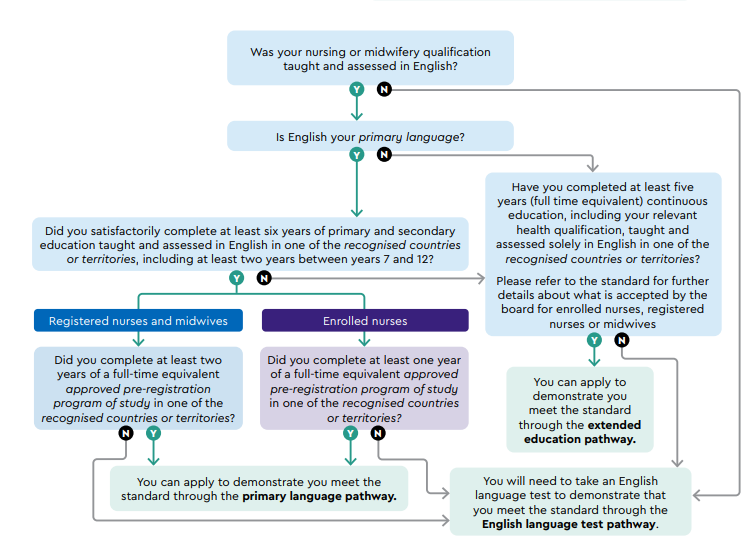
I grew up and studied in Australia. Which pathway do I use?
If you grew up and completed all your education in Australia, you should select the Primary Language Pathway.
Which countries are recognised for the Primary Language Pathway?
Recognised countries/territories include:
Antigua and Barbuda, Anguilla, Australia, The Bahamas, Barbados, Belize, Bermuda, British Indian Ocean Territory, Canada, Cayman Islands, Dominica, Falkland Islands, Gibraltar, Grenada, Guernsey, Guyana, Isle of Man, Jamaica, Jersey, Malta, New Zealand, Republic of Ireland, Saint Helena, Ascension and Tristan da Cunha, St Kitts and Nevis, St Lucia, St Vincent and the Grenadines, Trinidad and Tobago, United Kingdom, United States of America, and US Virgin Islands.
I didn’t attend secondary school in a recognised country, but I’ve studied in one for several years. Which pathway applies?
You may meet the ELS standard through either:
1. Primary Language Pathway, OR
2. Extended Education Pathway, if you can provide evidence of:
- At least five (5) years full‑time equivalent continuous education,
- Taught and assessed in English,
- In a recognised country,
- Including relevant tertiary qualifications in nursing or midwifery.
If your nursing or midwifery qualification was not taught and assessed in English in a recognised country, you must meet the ELS standard through the English Language Test Pathway.
Pathways diagram
If I hold a student or bridging visa, am I eligible to apply?
Candidates are eligible for the GNMP Match only if your visa grants you the Right to Work in Australia.
If both your current visa and the visa you plan to transition to permit lawful work in Australia, you may apply.
Please note:
- Health Services may request additional information or evidence about your visa status.
- PMCV cannot interpret visa conditions. You must confirm details independently via:
- Department of Home Affairs: www.homeaffairs.gov.au
- Your university’s international student office
I’m on a bridging visa without an expiry date. How should I complete my application?
Provide as much visa information as you can in your PMCV application.
- The visa expiry date field is not mandatory.
- You may add clarification in the comments section.
You should also mention your bridging visa in your CV/resume to Health Services to explain any missing details.
What visa types are eligible for the Match?
Visa categories listed as acceptable include those that provide the Right to Work in Australia now and into the future.
PMCV cannot advise on specific visa rights or restrictions.
Key points:
- Your visa must ensure you have unrestricted work rights for your graduate year.
- Health Services will use VEVO to verify your visa status.
- The list of acceptable visa categories was originally provided by the Department of Health, but requirements may change, so always check current information.
| Visa subclass | Work rights |
| 186 – Employer Nomination Scheme | Unlimited |
| 407 – Training visa | Workplace training visa, limits apply |
| 482 – Temporary Skills Shortage visa | Unlimited – must work in sponsored occupation and for sponsor only |
| 485 – Temporary Graduate visa | Unlimited |
| 491 – Skilled Work Regional visa | Unlimited in regional areas |
| 494 – Skilled Employer Sponsored Regional visa | Unlimited – must work in sponsored occupation and for sponsor only |
| 500 – Student visa | 48 hours a fortnight from 1 July 2023 (re-introduction of limit that was relaxed over COVID). Unlimited when course not in session. |
| Partner visa – 820 | Unlimited |
| Bridging visas | VEVO should always be checked as work rights differ from case to case |
| 189 – Skilled Independent visa | Unlimited |
| 190 – Skilled Nominated visa | Unlimited |
| Partner visa – 801 | Unlimited |
How does the matching process work?
PMCV uses a matching algorithm to allocate candidates to positions. It considers four key factors:
- Candidate’s Priority Group
- Candidate preference order
- Candidates list up to six preferred Health Services in their PMCV application.
- They must also apply directly to those Health Services.
- Health Service ranking of candidates
- Each Health Service reviews applications, scores them, and ranks candidates accordingly in APS.
- Number of available positions
- Each Health Service has a fixed quota for each nursing/midwifery stream.
How do allocations occur?
-
Priority Group 1 candidates are allocation by the algorithm first. Once allocations are complete, Priority Group 2 candidates are then processed and allocated where positions remain.
- You are allocated to your highest‑ranked preference where your ranking falls within that Health Service’s position quota.
- You can only receive one allocation, and the result is binding.
A detailed video explanation is available on “The Match” webpage.
Can I be allocated to a Health Service I didn’t preference?
No. You can only be allocated to a Health Service that appears in your preference list.
I have moved house and now live far from my listed preferences. What should I do?
If you can no longer accept an allocation Health Services, you must notify each Health Service by TBA
If you do not withdraw and you are allocated, the match is binding unless the Health Service grants a Release Letter (only in hardship, not guaranteed).
If You Are Successful
How do I accept my Graduate Position?
Click the acceptance button in your Candidate Portal.
How long do I have to accept my allocation?
You have 48 hours from the time results are released.
Why is there an acceptance period if the outcomes are binding?
Circumstances can change between June and September (e.g., exam failure, delayed placements, pregnancy, relocation).
Candidates with valid reasons may decline.
Acceptance allows Health Services to begin onboarding promptly.
What if I miss the acceptance deadline?
The Health Service will withdraw your allocation. If you have special circumstances, contact the Health Service immediately.
I’ve been matched—what happens now
- Accept or decline within 48 hours.
- After acceptance, the Health Service will contact you (within 1–2 days) to begin onboarding and issue a contract.
Will I get more offers or be considered by other Health Services?
No. The system gives you the best available outcome based on your preferences.
You will not hear from lower preferences.
If you decline the offer, you cannot receive further offers in the GNMP Match.
If You Are Unallocated
I wasn’t allocated. What happens next?
PMCV will re-run the algorithm about one week following the acceptance period, to fill any remaining vacancies caused by candidates declining or not responding to the allocations.
PMCV and/or the Health Services will have a process for the Unallocated Candidates. Details will be listed when they are available.
Can I decline my position?
Yes, but it has significant consequences:
- You may not be eligible for any further PMCV‑managed Graduate Program opportunities (including Late Vacancy Management).
- Health Services are aware of candidates who have matched and will breach the Code of Conduct to offer you positions in future.
Before declining, contact your allocated Health Service especially if the issue relates to placements, delayed completion, or parental leave. as they may be able to assist or offer a deferral.
Can I defer the start of my Graduate Year?
This is at the Health Service’s discretion. You must contact your allocated Health Service directly.
Important:
If you choose not to apply for a graduate year immediately after completing your studies, you become ineligible for PMCV matches in future years.
Am I eligible for release under exceptional circumstances?
Possibly. You may request a Release Letter from your allocated Health Service if you are experiencing hardship, and you must provide supporting evidence.
- Release Letters are issued at the Health Service’s discretion.
- You must present the Release Letter to any new Health Service before discussions can begin.
Without a Release Letter, you cannot apply elsewhere in the Match.
Can a Health Service withdraw my allocation?
Yes, in situations such as:
- No response to communications
- AHPRA registration not completed in time
- Right to Work or visa issues
- English Language requirements not met
- Failure to supply required documentation
- Police/WWCC checks not cleared
- Not meeting role requirements (e.g., vaccinations, rotations, shift patterns)
The Health Service will notify both you and PMCV if your allocation is withdrawn.
Is there a minimum or maximum FTE for graduate nurses and midwives?
FTE requirements are set by each individual Health Service. Graduates are generally employed between 0.6 and 1.0 FTE to support transition into practice. Contracts and onboarding are outside PMCV’s scope.
Securing two clinical referee reports is an essential part of your application process. There is a set timeframe to have these submitted and health services rely on the information they provide.
Do I have to ask the referee or can I just put in the details that I already have?
Always ask your referees for permission before nominating them. This is not only courteous but ensures they are willing and available at the specified time to complete your reports.
What should I ask my referee before I input their details?
The following information must be obtained directly from the referees. Inaccuracy when entering this information may lead to non-compliance by the referee.
- Title, First and last name
- Preferred email address
- Current job title
- Current health service of the referee
Who can be a referee?
You need to provide via PMCV two clinical referees. If you are unsure if a particular referee or placement is suitable, please speak to your university, as PMCV cannot provide this advice.
The referee must meet these criteria:
- Your referee must be a Registered Nurse (RN) or Registered Midwife (RM) with more than one year’s experience.
- Worked closely with you in your capacity as a student nurse or midwife and can provide an informed opinion of your suitability for the role.
- Accepted roles for referees include:
- Clinical Support Nurse/Midwife
- Clinical Preceptor (also known as a buddy or supervisor in some organisations)
- Nurse/Midwife Unit Manager
- Clinical Nurse/Midwife Consultants
- Clinical Nurse/Midwife Educator
- Clinical Facilitator
- If you can’t provide a second referee from a student placement, you can nominate:
- Clinical Supervisor from your time as a RUSON or RUSOM.
Some health services may request more than the two required referees as part of their own application. These referees’ reports must be written by the referee and submitted directly to the health service.
Can I put in a referee from another type of job which was non-clinical?
A non-clinical referee cannot address the questions within the PMCV Clinical Referee Template, therefore non-clinical referees’ names must not be entered into the PMCV candidate portal.
I’m unsure who I can nominate, who can I ask for advice?
Questions about appropriate referees, suitable placements, or alternatives must be directed to your university.
PMCV cannot advise on these matters.
Referee selection is ultimately your responsibility, with one exception:
- Non‑clinical referees are not permitted for the PMCV referee report.
Health Services—not PMCV—determine whether a referee report is acceptable.
I won’t complete my second placement before the Match closes. What can I do?
Health Services understand that training may still be in progress.
You should:
- Note the upcoming placement in your CV (include as much detail as possible).
- State that you can supply a reference upon request.
- Understand that PMCV cannot accept referee reports after the Match closes.
You may choose to:
- Use a second referee from your first placement, or
- Use a buddy nurse if they meet the referee criteria (see next question).
Ensure your CV clearly explains your situation.
Can I nominate my Buddy Nurse who has worked with me?
Yes—only if they meet the following criteria:
- They are a Registered Nurse (RN) or Registered Midwife (RM)
- They have more than one year of experience
- They have worked closely with you as a student and can assess your suitability
Is my placement suitable to use as an acute placement?
PMCV cannot answer this. Please seek advice from your university regarding placement suitability and referee selection.
I am working as an EN/EEN. Can I use references from this role?
This is not preferred. As referees should be from placements where you worked as a student Registered Nurse, as that is the role being assessed.

